Tuesday, June 17, 2014

The American Empire Post 3

For this part of the project, my group used Videolicious, an app used to record your voice over slides of pictures. We used pictures that pertained to our topic: Imperialism in America. In the slides, we explained our enduring understandings, and read quotes that related to it. With each member contributing at least one enduring understanding, we all got to hear what the other members of the group thought about the topic, which gave us a better understanding. One enduring understanding in particular being "Extreme nationalism creates people that are entitled, selfish, and unwelcoming to anyone unless they want to join their “utopian” society." This enduring understanding helped our group understand why United States felt they needed to be more involved in foreign affairs, and enact policies such as Manifest Destiny.

The photo essay comprised of a few main steps. The first being finding the pictures to represent the topic. The pictures chosen and arranged into groups of two, each group representing an enduring understanding. Next, we briskly recorded our points over the slides in order to fit the sixty second time limit Videolicious has. I think we did a pretty good job of relating our enduring understandings to our pictures and quotes, but perhaps alternating speaking in the video essay would have been better.

The sinking of the USS Maine. Used as an example of propaganda for the enduring understanding; "The press has much power, it is able to sway opinions and change minds."


Here is the link to our
Videolicious: http://video.videolicious.com/0d2c5fcb-0bea-4de1-824a-c9477a0fad0e
and 
Survey Monkey: https://www.surveymonkey.com/s/XTGHX5D


Monday, June 9, 2014

The American Empire Post 2

Key Terms and Definitions:

Imperialism - a policy of extending a country's power and influence through diplomacy or military force.

Nationalism - devotion to ones nation

Annex - to join a new territory to an existing territory

Arbitration - the settlement of a dispute by a person or panel that was chosen to listen to both sides and make a decision


Spheres of influence - areas of economic and/or political control

Reconcentrados - Cuban citzens who had been moved into concentration camps by the Spanish during the Cuban revolution.

Banana Republic - another name for the Central American nations, due to their exportation of bananas to the U.S.

Platt Amendment - amendment that the US would withdraw troops from Cuba, if they did not involve themselves in other foreign countries

Manifest Destiny - the widely held belief in the United States that American settlers were destined to expand throughout the continent (coined by journalist John O'Sullivan in 1845)

Spanish American War - A war started somewhat by the sinking of the U.S.S. Maine in 1898, America won and freed Cuba


U.S.S. Maine Incident - U.S. ship sunk in 1898, Spain blamed for sinking

Alfred T. Mahan - Captain (later admiral) who argued that Americas future hinged on gaining new markets abroad. influenced Roosevelt in expansion.

"Seward's Folly" - Alaska, when first purchased by the United States from Russia in 1867

The expansion of a territory will cause it to gain power and resources.
  • US Acquisition of Alaska gave them access to to its "rich resources". (American History: Pathways to the Present Chapter 17 Section 1)
  • The US Acquisition of Hawaii in 1853 allowed the United States exclusive access to Hawaii's sugar trade. (American History: Pathways to the Present Chapter 17 Section 1)

Wealthy people have more influence in their country than those of lower social class
  • Rockefeller brothers urging government to become more imperialistic and to develop more assertive polices (“The Empire and the People”)


Individuals that have obtained power, will only seek more in their conquest in order to expand their empire and its power.  
  • “In Cuba, alone, there are 15,000,000 acres of forest unacquainted with the axe. There are exhaustless mines of iron…. There are millions of acres yet unexplored….It means new employment and better wages for every laboring man in the Union….” (Albert J. Beveridge’s Senate campaign speech, September 16, 1898.)
  • “All the great masterful races have been fighting races… No triumph of peace is quite so great as a triumph of war.”(The Empire and The People, 300)


At the bottom of the "pyramid" we see the reconcentrados, or the Cubans put into concentration camps at the time of the Spanish-American War. These people had no rights during the war, and had to accept the terms of the treaty as they were. These Cuban citizens were also subject to U.S. military intervention until the Platt Amendment was instituted. The war had a severe impact on these people for years after the peace, a lasting wound caused by America's imperialistic ideals.


Tuesday, June 3, 2014

The American Empire Post 1

The unit that we are currently on is about how people, places, and power can affect different societies. These three things can have a huge impact on the world, and changing it for the better, or for the worse. My group selected the topic: Imperialism in America, which is about the expansion of America's influence and trade throughout the rest of the world.

Key Terms and Definitions:

Imperialism - a policy of extending a country's power and influence through diplomacy or military force.

Nationalism - devotion to ones nation

Annex - to join a new territory to an existing territory

Banana Republic - another name for the Central American nations, due to their exportation of bananas to the U.S.

Manifest Destiny - the widely held belief in the United States that American settlers were destined to expand throughout the continent.

George Washington - first president, advised Americans to "steer clear of permanent allies"

James Monroe - established Monroe Doctrine; main principle of foreign policy, broadened to support American Imperialization


Alfred T. Mahan - Captain (later admiral) who argued that Americas future hinged on gaining new markets abroad. influenced Roosevelt in expansion.

"Seward's Folly" - Alaska, when first purchased by the United States from Russia in 1867

Enduring Understandings:

The expansion of a territory will cause it to gain power and resources.
  • US Acquisition of Alaska gave them access to to its "rich resources". (American History: Pathways to the Present Chapter 17 Section 1)
  • The US Acquisition of Hawaii in 1853 allowed the United States exclusive access to Hawaii's sugar trade. (American History: Pathways to the Present Chapter 17 Section 1)
Wealthy people have more influence in their country than those of lower social class
  • Rockefeller brothers urging government to become more imperialistic and to develop more assertive polices (“The Empire and the People”)

This topic represents the theme, "People, Places, and Power", in a few ways. The expansion of American influence caused the United States to gain power through foreign trade markets, annexation of new territory, or investing in new nations such as the ones in Central America. Men such as Alfred T. Mahan would classify as a "person" in this theme. He argued how America needed to venture abroad into new trade markets, breaking free of anti-foreign policy set by James Monroe. Some examples of power would include the Rockefeller brothers influencing the government. The Rockefeller brothers, being very wealthy, had a large influence on the United States, pressuring them to adopt more dynamic foreign policies for their benefit.


Thursday, May 29, 2014

The Autopsy of the Reconstruction

The South kidnapped, beat, stabbed and shot the Reconstruction dead. The Reconstruction was a movement after the Civil War that was designed to rebuild the South and give equal rights and protection to the blacks. The violent attacks in the South led by racist white groups such as the KKK ruined the rebuilding of the South and forced the North to stop their efforts. Even though the North took a part in the fall of the Reconstruction, the South played a much bigger role in its demise. The South killed the Reconstruction with its vicious attacks and threats toward blacks and supporters of the Reconstruction.

Violence towards blacks and black supporters was not a strange occurrence in the South during the Reconstruction. Blacks were constantly being terrorized by racist southern men. One of the most infamous groups, the Ku Klux Klan, earned their reputation by terrorizing and killing anyone who supported blacks or the Reconstruction. It mattered not who, when, or where, the KKK terrorized anyone who they believed supported the blacks. One account from Albion Tourgee, a judge and former white Northern soldier, tells of the KKK murdering former state senator John W. Stephens in the courthouse he worked in. He was "stabbed five or six times, and then hanged on a hook in the Grand Jury room."(Document A) Tourgee fears he will become another victim of the KKK's brutal attacks. He closes the letter with his own stance on the current state of the KKK outbursts, saying "any member of Congress who, especially if from the South, does not support, advocate, and urge immediate, active, and thorough measures to put an end to these outrages ... is a coward, a traitor, or a fool"(Document A)

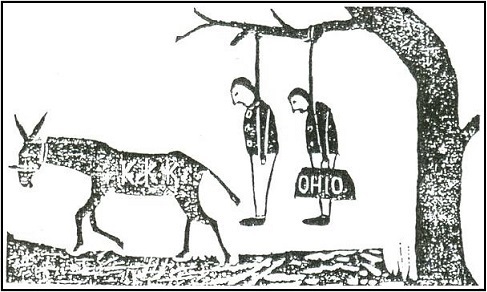
This cartoon above is a threat from the KKK, warning any carpetbaggers and scaliwags they will be killed by the KKK for supporting blacks and the Reconstruction.


Intimidation was a tactic used by Southerners to stop the progress of the Reconstruction. With the introduction of the 15th Amendment, blacks were legally given the right to vote. Racist groups such as the KKK however, used tactics such as bribery, kidnapping, and assault to keep blacks from having a say in government. A black man by the name of Abram Colby fell victim to these acts at the hands of the KKK. He says the Klansmen: "broke my door open, took me out of bed, took me to the woods and whipped me 
three hours or more and left me for dead. They said to me, 'Do you think you will ever vote another damned Radical ticket?'"(Document B) Colby says that: "No man can make a free speech in my county. I do not believe it can be done anywhere in Georgia."(Document B) The blacks in the South had their hands tied by the KKK, who essentially made the 13th, 14th, and 15th Amendments null and void in the South. This made any and all Reconstruction progress futile and in vain.

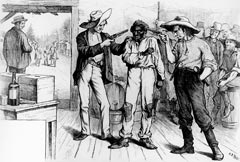
The photo above is titled: "Of Course He Wants to Vote the Democratic Ticket". This photo shows how blacks were threatened with death if they did not vote with the racist southerners. This is reflected by the black man held at gunpoint in the photo, and the photos sarcastic title.

The South killed the Reconstruction by attacking and threatening anyone who supported it. Although the North had abandoned the South, they cannot be held responsible for the actions of the KKK and other racist groups in the southern states. Trying to put the fall of the Reconstruction on the North is futile because at the end of the day, it was the South with the problems, and it was the North trying to help them. They cannot be put at fault for not being able to handle the vicious nature of the southern racists.

Document A -Independent Monitor, September 1, 1868. Alabama Department of Archives and History, Montgomery, Alabama.
Document B - Abram Colby, testimony to a joint House and Senate Committee in 1872

Monday, April 7, 2014

What Doesn't Kill You, Makes You Stronger

Blacks in United States had the opportunity to gain advancement by submitting themselves to discrimination. The blacks could serve in the Union army and, essentially fight for their freedom. The question is, is it worth it to endure discrimination in order to get yourself higher? Or is it better to remain where you are and not tolerate the extra abuse?

I believe that, in the free blacks in United States, it would be better to withstand the discrimination in order to gain advancement. After fighting alongside the whites in the Civil War, many blacks were rewarded and treated better than they were before. In the case of Silas Chandler, it was definitely worth it. Silas was a slave to a white man who served in the Confederate Army. Silas also served in the army with him, and was discriminated for being a black soldier and technically not being free. After his service, he was rewarded with freedom and a new church near his property from his old master. This was worth the discrimination in the end and allowed Silas to gain freedom and a church for him and his community.

The Chandler tintype showing Silas (left) and his master (right)

Monday, March 24, 2014

Women in the Civil War

During the Civil War, women were expected to act a certain way. They were expected to cook, clean, and take care of the children. It was not looked favorably upon for a woman to have a job outside the home or act "like a man". These set of constraints are known as the Sphere of Domesticity. Some women in the Civil War chose to make an impact while staying inside the sphere, while others chose to break out from the sphere to aid others.

One woman, Belle Boyd, strayed out of the sphere by acting as a Confederate spy. She stole weapons from confederate camps and flirtatiously tricked union soldiers. Belle Boyd is a prime example of a woman not being inside the Sphere of Domesticity. She chose to act outside the sphere because of an encounter she had with a Union soldier. A drunk group of soldiers tried to raise a Yankee flag above her home. She then was threatened by a soldier, then she killed him, leaving her with a sense of revenge for the soldier trying to convert her house to a "yankee house".

Belle Boyd


Another woman, Alice Chapin, chose to stay more inside the sphere. Her husband forbade her from getting a job while he was at war, so she decided to aid the troops. She did not however volunteer as a nurse, she chose to send care packages full of food, soap, and stamps.

Alice Chapin

Monday, March 17, 2014

The Union Needs You!

Today I am faced with a tough decision. The North and South have split from each other. The North is forming an army, they call it the Union. Even though I want to serve my country in war, I cannot help thinking what could become of me. I have seen how people do not always come back from war, and what kind of people they have become when the return. One thing eases my mind, the technology that the Union has is very advanced.

One of the advances was the new types of rifles and slugs. These rifles were deadly at up to half a mile and the slug rounds used caused many more amputations. The repeating gun, the forerunner of the machine gun was also a factor.

One of the rifles used by the Union in the Civil War

Battles Blog Post

The lesson our class participated in was about the battles of the Civil War. Each student was assigned a brief description of a battle, numbered 1-20, which they would be required to do research on. The student then would have to make a Google Doc and put their information on there and acquire the link to the doc. The link to the document would then be converted into a QR code. Each student would print their code out and hide the codes throughout the school, with directions on how to get to the next QR code. The students would then start at the code after their own, and carry out the scavenger hunt, taking notes on the battles as they examine the Google Doc. After the hunt was over, the students would contribute their answers to the essential questions on an online wall called Padlet. Each student would post their name and answer to the wall and each answer would be read over.

Example QR code used in Scavenger Hunt


In the Eastern theater, the ultimate victor was the Confederate Army. In the Western and Naval Theaters, the Union was the winner. The Eastern Theater was won by the Confederate Army early on in the Civil War. The Confederate Army won just about every battle at the beginning of the war. Towards the end of the war, about 1863 and on, the Union started to win battles such as Gettysburg and Antietam. The Western Theater was dominated by the Union for the entire war. The Union won so many battles in this theater because they were able to get supplies to their troops much easier than the Confederate Army could. The Union also won the Naval Theater because of the blockade of the Southern ports. The South already had a worse economy than the North, and not being able to ship cotton to Europe in exchange for supplies crippled their economy and lost them the theater and eventually,  the war.

Wednesday, March 12, 2014

Timeline Post

My group was assigned The Kansas Nebraska Act as one of the causes of the Civil War. We were also assigned to make a timeline to show each event. All of the events are shown below on the timeline with their respective dates and titles.


Monday, March 10, 2014

Civil War Infographic

I chose to set up my infographic the way I did for a few reasons. I chose to give the advantages of both sides to show how each side had different things they could use to defeat the other side. For example, the Northern side could use their overwhelming numbers and better manufacturing to cripple the South, or the South could use their defensive position and will to fight to fend off the Northern attack. I also included a word web to convey the ideas and strategies associated with each side. I also chose to make each side represent a certain color, North red, South blue, so that the info on it can been seen and immediately recognized as North or South. This all went into consideration in the design of my infographic.

The infographic can be found here.

Tuesday, February 18, 2014

The EdCafe Experience

EdCafe was different from our normal routine in class. Getting to choose which topic I would like to hear about makes learning about it much more interesting. Although I myself do not enjoy talking in class much, I liked how the discussion kept circulating between the presenters and the attendants. I enjoyed the topics that were presented and learned a thing or two from them all. Presenting wasn't as bad as I thought it would because the discussion seemed like a regular conversation rather than a Socratic seminar type activity because of the small group of people. Overall, this was a unique experience and I would not mind having it again.


This is a photo of Harriet Jacobs, whose story was used as part of our EdCafe Presentation

Monday, February 3, 2014

Think Like a Historian

Slavery in the U.S. during the 19th century was a very controversial practice due to the northern half of the U.S. opposing it, and the southern half supporting it. The North however, was not totally against slavery. Almost all of the north knew that slavery was morally wrong, but some would still participate in the slave trade against their own principles.

The North had people that participated in the slave trade and also people who opposed it. Some people would go as far as silence anti-slavery movements just so that their town doesn't get a bad reputation with the southern states and lose business. William Lloyd Garrison was actually chased out of Boston when he tried to speak publicly about the abolition of slavery. People in the north knew that slavery was immoral, but they chased a man out of town because they did not want to ruin the reputation of the north to the south.

I would simply publish all of the stories including the one of Garrison in order to show the world how the North was corrupt when it came to slavery. I would include charts like how the North relied on the cotton production of the South, so the North would not want to ruin the relation between them and the South over slavery, and how The Lowell Patriot called people like Garrison "fanatics" for the same reasons. That is how I would share my information with the world.

Above is a picture of William Lloyd Garrison, an abolitionist who was run out of Boston for speaking out against slavery in public.

Tuesday, January 7, 2014

The Protestant Revival

The Protestant Revival was a movement in the 19th century that pushed change in the behavior in society such as alcohol consumption, slavery, celibacy and more. The average annual alcohol consumption per capita in the 19th century was about 7 gallons. That is over twice the amount now a days. The Revival responded to this by promoting freedom. Freedom was meant as the freedom of the temptation to sin, rather than the freedom to sin. Slavery was also a big topic of the movement. The radical abolitionists preached to the north that slavery was a sin and that all men should be free and have equal rights. This lead to 100,000 northerners to be allied with the anti-slavery society. Lastly, the movement promoted celibacy. Many "utopian" societies broke off from the new industrialized market economy so that they can practice their own ways. One of the groups was the Shakers, who practiced celibacy. They had equality between men and women and was one of the most successful utopian societies. This was what the Protestant Revival was all about.


This photo shows the Shakers dancing, a custom they practiced to help suppress their "libidinous urges"