
Wednesday, November 27, 2013
King Andrew VII

Friday, November 22, 2013
Democracy Doesn't Come Cheap
Democracy should be defined as a form of government where free adult citizens vote for their own leader. This view of democracy was very different than how the 19th century U.S. viewed it. The U.S. used to base voting rights off of how wealthy you were or how much land you owned. The theory was that a citizen had to have some stake of the city that they were voting in to have a vote. This is flawed because some people who are unworthy or unqualified to vote can do so because they have land, but someone with no land cannot vote, no matter how qualified. This quote by Benjamin Franklin illustrates how the U.S. valued property over experience. “Today a man owns a jackass worth fifty dollars and he is
entitled to vote; but before the election the jackass dies. The man in the meantime has become more
experienced, his knowledge of the principles of government, and his
acquaintance with mankind are more extensive, and he is therefore better
qualified to make a proper selection of rulers – but the jackass is dead and
the man cannot vote. Now gentlemen, pray
inform me, in whom is the right of suffrage?
In the man or in the jackass? This quote is questioning what gives the right for an individual to vote. Franklin obviously favors having suffrage given to men with more experience than ones with wealth. In today's world, you could be the richest person in your town, but if you are not suitable to vote for a leader, then you do not get to vote.

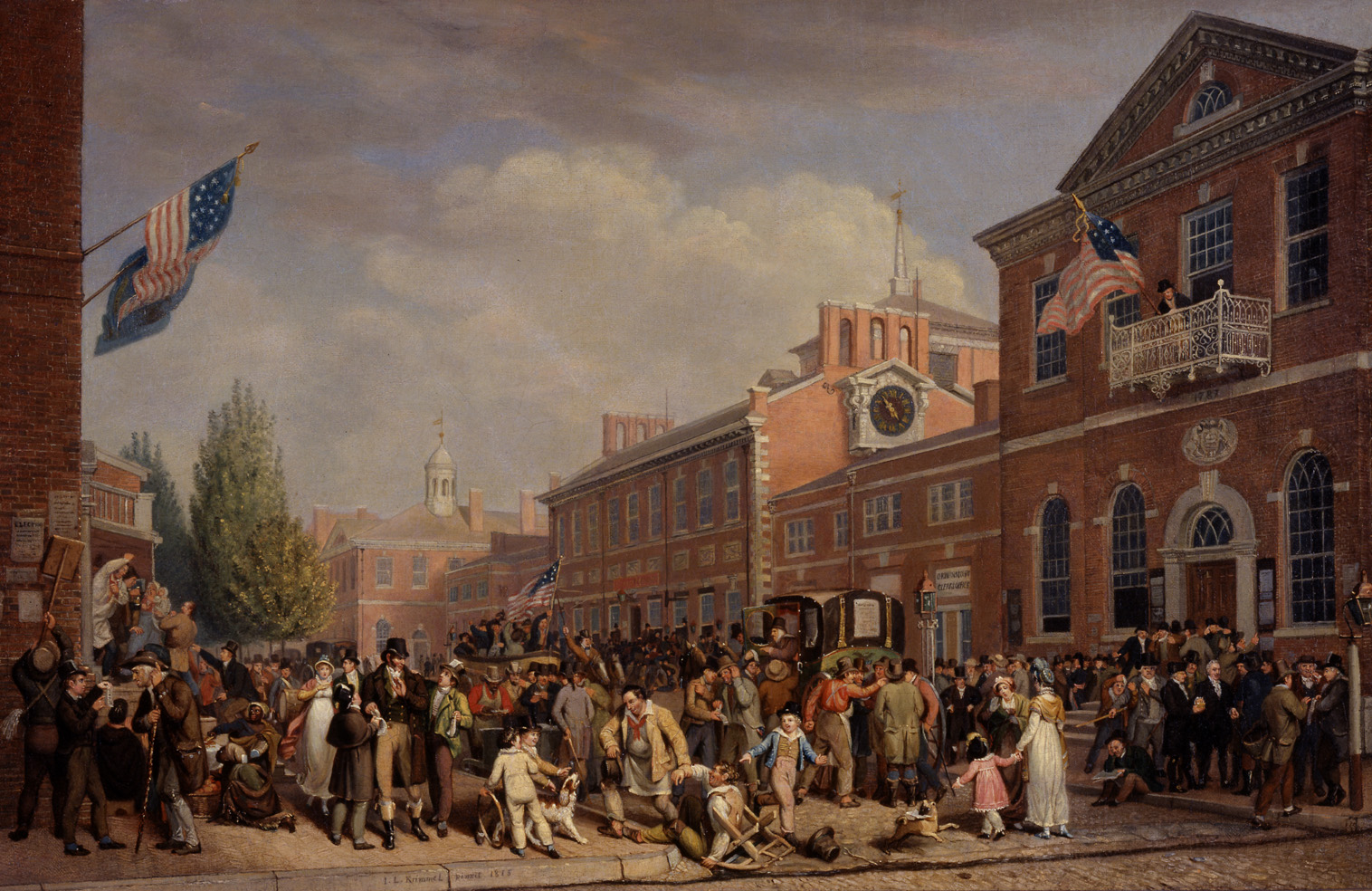
This photo shows a scene from a 19th century election in a town square.
Wednesday, November 20, 2013
Romanticism

Four themes of Romanticism are awe of nature, focus on the individual, grotesque artwork, and emotional thought.
Romanticism was a movement in reaction to the Enlightenment. The qualities of Romanticism directly contradicted Enlightenment ideas. While the Enlightenment was focused on the control of nature, focus on the majority, beautiful artwork, and intellectual thought, Romanticism was geared towards the awe of nature, focus on the individual, grotesque artwork, and emotional thought. Awe of nature is shown in this painting because of the valley the pilgrim is in. The walls are so tall, he can barely even see the sun. He is puny and powerless in comparison to nature so that is why this painting shows awe of nature. There is only one person in this painting, and he is in the foreground of the painting, so that shows that this painting focuses on the individual, like the Romanticist movement. This painting is not very clear and is not strictly beautiful. The painting has the Romantic quality of being grotesque for this reason. The painting also provokes emotional thought. When looking at this painting, many questions come to mind. What is that man doing there? How did he get there? Where is her going? Many questions like that arise when looking at the painting. This is hwo this painting shows four themes of the Romanticist movement.
Monday, November 18, 2013
Revolutions of 1830 & 1848
In 1830 and 1848, there were many revolts within Europe. These revolts were fueled by liberal, republican, and nationalist ideas. Although many of these revolutions were unsuccessful, they still are very important in history. Three of the revolutions that took place in this time period will be judged by their success and failure.

The Decemberist's Revolt of 1825 took place in Russia. This revolution was driven by the people, who wanted liberal changes in the form of a new constitution. Already upset by the fact that Poland, a country Russia had defeated, was given a new constitution by Russia, the people planned to kill the Russian leader, Tsar Alexander. But before they could execute their plan, Tsar Alexander died, leaving Tsar Nicholas the throne. Knowing that Tsar Nicholas was a conservative. meaning it was unlikely that Russia would receive a new constitution in the near future, the people attempted to take advantage of the transition of power, and started a revolution against Tsar Nicholas. At first, the Tsar was hesitant on resisting the revolt of his own people, but soon after he swore that all revolutionists would be dealt with no mercy. The revolution was almost a complete and utter failure. No changes were made, and the people actually lost some rights.
The French Revolution of 1830 was the first of two revolutions within an 18 year period in France. The reason for the revolution was because Liberals wanted a constitutional monarchy instead of an absolute monarchy. The Radical Republicans wanted to eliminate the monarchy all together and create a republic in France. The French people set up barricades in the streets and killed soldiers to try to rebel against Charles X. The French people managed to force King Charles X out of France, leaving Louis Philippe to take the throne. This did not work out very well for the majority of the French people because only the upper bourgeoisie gained anything. The vast majority of the French people still could not vote. The revolution was not very successful because only the upper class received any rights.
The French Revolution of 1848 was the second of the two revolutions within an 18 year period in France. This revolution was fueled by Radical Republicans wanting to end private property, and liberals wanting extended suffrage. The recession in France also sparked the revolution, causing Louis Philippe to renounce his throne. He was replaced by Louis Napoleon, the nephew of Napoleon Bonaparte. Louis Napoleon held the majority of the votes out of the nine million Frenchmen that voted. However, Louis Napoleon declared himself emperor and basically put the French people back to square one. This revolution was partly a success and partly a failure because while they did get what they wanted by having the right to vote for Louis Napoleon, they ended up having their suffrage taken away again when Louis Napoleon declared himself emperor.
The photo above is an allegory that shows the French people fighting in the French Revolution of 1848
This is the link to the Decemberist's Revolt Project: http://www.showme.com/sh/?h=kaaANVo
Thursday, November 7, 2013
The Monroe Doctrine
The US reacted to the dominant conservative ideology of the Quintuple Alliance by doing three things. One thing they did was negotiate the western seaboard with Russia. Russia claimed the territory belonged to them, when the US and other countries had a share of it. The US resolved this by telling Russia they could not just claim land that belonged to the US. Another way the US reacted was preventing anymore European colonization in the Western Hemisphere. The Monroe Document clearly states: "by the free and independent condition which they have assumed and maintain, are henceforth not to be considered as subjects for future colonization by any European powers...." The US told the Alliance that if they tried to retake the old Spanish colonies, the US would fight with the old colonies to prevent it. The last way the US responded was not forming an alliance with Britain. The US decided to not be involved with Europe any longer and decided it will be more involved in world matters, not letting the world be run solely by Europe any longer.

This quote is an example of the US not letting Europe recolonize the western hemisphere. The rest of the world would have been unhappy and a little shocked by this quote. They would have been shocked that a country that became independent not even 50 years ago was prepared to defend against European colonization. The facial expression in the picture represents the US Congress's reaction to the quote. They are pleased because they do not want Europe to have any colonies in the Western Hemisphere.

This quote is an example of the US not letting Europe recolonize the western hemisphere. The rest of the world would have been unhappy and a little shocked by this quote. They would have been shocked that a country that became independent not even 50 years ago was prepared to defend against European colonization. The facial expression in the picture represents the US Congress's reaction to the quote. They are pleased because they do not want Europe to have any colonies in the Western Hemisphere.
Tuesday, November 5, 2013
Congress of Vienna
One of the concepts discussed at the Congress of Vienna was the Holy Alliance. The congress used the Holy Alliance as a way to suppress future rebellions in Europe. The countries in the Alliance would use the Principle of Intervention to help each other should a rebellion form. This was put in place as a response to the Haitian Revolution. This concept would have pleased Metternich greatly because it would help keep the monarchy in power. Metternich was a conservative, so he did not want the political system to change. The Holy Alliance helped stop many rebellions that arose after the Haitian Revolution and kept the monarchy in power in Europe longer.

Above is a picture of the countries in the Holy Alliance
Sunday, November 3, 2013
Vine Ideologies
Our Vine helps define the ideology of nationalism. Nationalism is the ideology of standing behind and supporting ones country. The two people wearing Italian flags symbolize the citizens of Italy. The shaking of hands symbolizes them joining forces to fight the foreign ruler. The person with the crown symbolizes the foreign French ruler. The two Italian citizens take down the foreign ruler because they are nationalists and will not stand for a French man to rule Italy. Nationalism inspired countries to revolt against foreign rulers, such as Italy did with France.
The other two ideologies that influenced the social and political actions of the 19th century as well. Conservatism was the ideology that tradition was the only way to tun government. This ideology was used when the Holy Alliance was formed. The Holy Alliance was formed after the Haitian Revolution to help stop any future uprisings. Another example is Joseph de Maistre's Essay on the General Principle of Political Constitutions, which opposed reform and change. The alliance wanted to keep the monarchy strong and to keep old traditions. The other ideology is Liberalism. Liberalism is the ideology of reform. Liberalism was an idea in Adam Smith's Wealth of Nations. Liberalism also affected the Haitian Revolution because the slaves wanted change so they revolted against the conservative French government and reformed their society.
Subscribe to:
Posts (Atom)